

Imagine walking into your kitchen. You place your car keys on the counter. You walk away, make a cup of coffee, and return. The keys are gone.
You search the counter. Nothing. You check your pockets. Empty. You ask your partner if they saw your keys.
They look at you with a mixture of pity and annoyance. “You left them in the car again,” they say. “You always do this.”
You walk out to the driveway. Sure enough, the keys are sitting in the car cup holder. You feel a sudden wave of confusion. You could have sworn you brought them inside. You feel a pinch of self-doubt. Is my memory getting worse? Am I losing my mind?
What you do not know is that your partner took the keys off the kitchen counter while you brewed your coffee. They walked out to the driveway, unlocked your car, and tossed the keys inside. They did this on purpose.
This is gaslighting. It is not a simple lie. It is a systematic attack on your perception of reality. Over time, this behavior erodes your trust in your own senses, your memory, and your sanity.
How do people do this? Why do they do it? And how can you protect your mind from this quiet, destructive form of manipulation? Let us break down the anatomy of gaslighting.
The Origin of the Word
To understand gaslighting, we must look at where the term came from. The word comes from a 1938 play called Gaslight, which later became a famous 1944 film starring Ingrid Bergman.
In the movie, a husband named Gregory wants to steal his wife Paula’s hidden family jewels. To get them, he needs to search the attic of their house. Whenever he goes up to the attic and turns on the gas lights, the lights in the rest of the house dim because they share the same gas line.
Paula notices the dimming lights. She also hears strange footsteps coming from the empty attic.
When she asks Gregory about these things, he denies them. He tells her she is imagining things. He claims the lights are bright and the house is silent. He convinces her friends that she is losing her mind. Eventually, Paula stops trusting her own eyes. She relies entirely on Gregory to tell her what is real and what is not.
This is the core of gaslighting: one person manipulates another into doubting their own reality so the manipulator can maintain control.
The Invisible Weapon: How Gaslighting Works
Gaslighting does not happen overnight. It is a slow poison. If a partner or boss tried to rewrite your reality on day one, you would walk away. Instead, they apply the pressure slowly, turn by turn, like tightening a screw.
Manipulators use a specific set of tools to achieve this control. Here are the five main tactics they use.
1. The Bold Lie
Gaslighters lie to your face with absolute confidence. They do not flinch. They do not look away. They state false things as absolute facts.
Even if you have proof, they will not back down. They will say, “I never said that,” or “That never happened.” They say it with such conviction that you begin to doubt your own memory. You start to ask yourself: Did I misinterpret what they said? Did I write down the wrong date?
By lying so boldly, they establish themselves as the ultimate authority on truth.
2. Countering Your Memory
When you bring up a specific event, a gaslighter will challenge your recollection.
-
- “You have a terrible memory.”
-
- “You always twist things around.”
-
- “That is not how it happened at all.”
They do not just disagree with your version of the story; they attack your ability to remember things correctly. Over time, you stop trusting your memory. You start relying on their version of history because it is easier than fighting an uphill battle.
3. Diverting and Accusing
When you confront a gaslighter with a mistake they made, they will quickly shift the focus. They turn the tables and accuse you instead.
If you say, “You didn’t pay the electricity bill like you promised,” they might reply, “Well, if you didn’t waste all our money on groceries, we wouldn’t have this problem!” Or they might say, “Why are you always looking for things to fight about?”
Suddenly, you are no longer talking about the unpaid bill. You are defending your spending habits or your personality. The gaslighter successfully escapes blame and puts you on the defensive.
4. Minimizing Your Feelings
To a gaslighter, your emotions are always wrong, exaggerated, or crazy.
-
- “You are too sensitive.”
-
- “It was just a joke.”
-
- “You are making a mountain out of a molehill.”
When someone constantly minimizes your feelings, you learn to hide them. You begin to think your feelings are indeed invalid. You stop speaking up when you feel hurt, which gives the manipulator even more space to mistreat you.
5. Using What You Love as Ammunition
A gaslighter knows what matters to you. They know your soft spots. They will use your kids, your career, your passions, or your identity to attack you.
If you love your job, they might say, “It’s a shame you care more about your career than your family.” If you are proud of your parenting, they might say, “Our kids would be better off if you weren’t so anxious all the time.”
By attacking the things that define you, they shake your core identity. They leave you feeling weak and dependent on their approval.
The Three Stages of Gaslighting
Gaslighting works in phases. Dr. Robin Stern, a psychoanalyst and author of The Gaslight Effect, identifies three distinct stages that victims experience.
Stage 1: Disbelief You fight back and trust your own mind.
Stage 2: Defense You argue, search for proof, and feel obsessed.
Stage 3: Depression You stop fighting, apologize, and accept their reality.
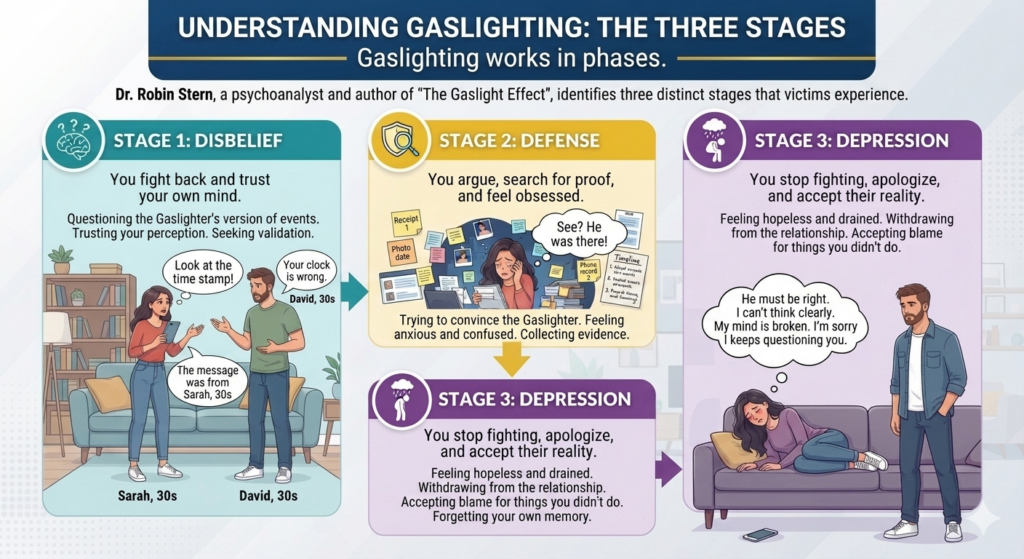
Three Stages of Gaslighting
Stage 1: Disbelief
In this first stage, you still trust your own mind. When the manipulator lies or twists the truth, you think they are wrong, confused, or just having a bad day.
You might think, That is strange. I know I sent that email, but they say they didn’t get it. They must have missed it in their inbox. You might argue with them, but you do not take the argument to heart. You still feel secure in your own reality.
Stage 2: Defense
In the second stage, you start to lose your footing. You no longer view the manipulator’s comments as simple mistakes. You feel the need to defend yourself constantly.
You spend hours arguing with them. You search through old text messages to prove your point. You take screenshots. You rehearse arguments in your head while you shower. You feel obsessed with proving that you are right and they are wrong.
However, you are also starting to wonder if they might have a point. You worry that you really are too sensitive or too forgetful.
Stage 3: Depression
This is the most dangerous stage. You have stopped fighting. You no longer try to prove your point or show them the evidence. You are too tired.
In this stage, you actively agree with the manipulator. If they say you ruined the evening, you apologize immediately. You accept their version of reality because it is the only way to keep the peace. You feel anxious, helpless, and completely isolated. You look in the mirror and do not recognize the person looking back at you.
Why Do People Gaslight?
It is easy to look at a gaslighter and see a criminal mastermind. In reality, most gaslighters do not have a grand, villainous plan. Their behavior usually stems from deep-seated psychological issues.
The Need for Control
At its heart, gaslighting is about power. The manipulator wants to control the relationship. If they can make you doubt yourself, you will look to them for answers. You will depend on them for your sense of security. This dependency makes them feel powerful and safe.
Inability to Accept Responsibility
Many gaslighters have narcissistic personality traits. They have fragile egos. They cannot tolerate the idea of being wrong, making a mistake, or being the “bad guy.”
If they make a mistake, their brain cannot handle the shame. To protect themselves, they rewrite the narrative. In their mind, they didn’t make a mistake—you did. They believe their own lies because the alternative is too painful for their ego to bear.
Defense Mechanisms
Some people learned to gaslight during childhood. They grew up in environments where survival meant denying reality or blaming others. They carry these toxic coping mechanisms into their adult relationships. To them, manipulation is simply how people get their needs met.
The Real-World Damage: Why It Hurts So Deeply
Physical abuse leaves visible bruises. Gaslighting leaves invisible scars that can take years to heal.
When someone rewrites your reality, they damage your psychological foundation. We navigate the world using our senses, our memories, and our intuition. Gaslighting breaks these internal compasses.
When you cannot trust your own mind, you experience:
-
- Hypervigilance: You are always on edge, waiting for the next conflict. You walk on eggshells to avoid triggering the manipulator.
-
- Decision Paralysis: You struggle to make simple decisions, like what to wear or what to buy at the grocery store. You constantly fear making the “wrong” choice.
-
- Loss of Identity: You lose touch with your opinions, your tastes, and your values. You become a shadow of your former self, existing only to appease the other person.
-
- Deep Isolation: You stop talking to friends and family. You feel embarrassed by your relationship, or the manipulator has convinced you that your loved ones do not care about you.
How to Reclaim Your Reality
If you read this and recognize these patterns in your life, do not despair. You can break free from the gaslight. You can rebuild your trust in yourself.
Here is how you can begin to reclaim your mind.
1. Identify the Pattern
You cannot fix a problem until you name it. Start paying attention to how you feel after conversations with this person.
Do you often feel confused? Do you find yourself apologizing constantly? Do you feel like you can never win an argument, even when you have clear facts?
Recognize that this is not a normal disagreement. It is manipulation.
2. Stop Arguing (Disengage)
You cannot win an argument with a gaslighter. They do not want to find the truth; they want to win.
When you argue, you give them power. You show them that their version of reality is up for debate.
Instead of arguing, disengage. Use neutral, firm language:
-
- “We remember things differently.”
-
- “I know what I saw, and I am not going to argue about it.”
-
- “I am leaving this conversation now.”
Once you say your piece, walk away. Do not stay to hear their rebuttal.
3. Keep a Written Record
When you doubt your memory, you need objective proof. Start keeping a secret journal or a digital document.
Write down events immediately after they happen. Include dates, times, and direct quotes. Save text messages, emails, and photos in a secure place.
When the manipulator tries to tell you that an event never happened, do not show them your journal. That will only trigger a new argument. Instead, read your journal privately. Use it as a personal anchor to remind yourself: I am right. My memory is correct. I am not crazy.
4. Build a Support Network
Gaslighters thrive on isolation. They want to be your only source of information.
Break this isolation by talking to people you trust. Reach out to old friends, family members, or a professional therapist.
Share your experiences with them. Ask them for their honest perspective. A trusted friend can act as a reality check. They can confirm that your feelings are normal and that the manipulator’s behavior is toxic.
5. Practice Self-Compassion
You might feel angry with yourself for letting this happen. You might wonder how you could have been so blind.
Be kind to yourself. Gaslighters are skilled manipulators. They targeted you because you are likely an empathetic, caring person who wants to give others the benefit of the doubt. That is a strength, not a weakness.
Forgive yourself for the time you spent in the fog. Focus on the steps you are taking to step out into the light.
The Path to Healing
Reclaiming your reality takes time. When you leave a gaslighting relationship—whether it is a romance, a friendship, or a job—the confusion does not vanish immediately. You will still have moments of doubt. You will still double-check your emails and question your decisions.
But slowly, like a muscle that has been out of use, your confidence will return.
You will make a decision, and you will not look back. You will remember an event, and you will not need someone else to validate it. You will look at your keys on the kitchen counter, and you will know exactly how they got there.
Your mind belongs to you. No one else has the right to rewrite the story of your life. Trust your eyes. Trust your gut. Trust your truth.